
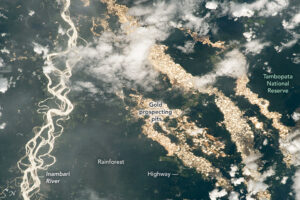
This extraordinary image of a region in Peru’s eastern Amazon went viral in the last week. The photo was taken at the end of last year by a NASA scientist on the International Space Station and shows gold prospecting pits in the Madre de Dios region. Freakishly, the pits, often hidden from view by cloud, were highlighted by the sun shining at just the right angle to generate glint. It is worthwhile looking at the higher resolution version of the image.
The image has drawn fresh attention to the problem of illegal gold mining and the damage it does in creating a culture of corruption, abuse, and slavery, whilst causing huge damage to health and the environment and lowering public sector revenues.
Much documentation already exists of the conditions in the illegal mining camps in Madre de Dios and the way women, particularly young women desperate for a future, are seduced by offers of employment into what turns out to be a life of abuse and slavery. Small groups pan for gold, often ignorant of the dangers of using mercury to extract the ore. This brings terrible consequences for their own health and for river pollution downstream. The fish on which communities rely for sustenance are poisoned, as are their animals and soil.
Artisanal and small-scale mining is particularly prevalent with the alluvial mining in the Amazon region, much less so amid hard-rock mining in the Andes.
Documentation of such activity, notably by the MAAP project launched in the Andean region in 2015, has slowed the rate of deforestation in the better-known areas. But, as with squeezing a balloon, improvements in one place are accompanied by further deforestation rates elsewhere. In its December 2020 report, MAAP identified 1,115 hectares of new mining deforestation across six areas of the Amazon rainforest when compared with the previous year. The MAAP project is an initiative of Washington D.C.-based Amazon Conservation and Peru-based Conservación Amazónica (ACCA). Along with other local partners in the Amazon region, it has provided invaluable documentation of deforestation trends.
In the same week, an excellent report on illegal and informal gold mining in Colombia was published by the Washington thinktank, Global Financial Integrity, raising many points that are relevant to Peru. It shows how, across Latin America, criminal groups have shifted from producing and trafficking narcotics to gold. It quotes the US Department of State as saying that “in the last ten to fifteen years, some transnational criminal organizations in the Western Hemisphere realized gold trafficking can provide them higher and easier returns than cocaine trafficking.” (p11).
The report emphasizes that long-established informal gold panning, which has gone on for decades, needs a different framework of support and management than that required to control illegal networks. This is absent in Colombia. The PSG report of 2012 demonstrates how pertinent this is for Peru.
While mercury remains cheap and effective, it will continue to be used and a careful policy of support is needed to eliminate it whilst mitigating the environmental damage it causes. The destruction of machinery just damages community livelihoods and much else besides. Operation Mercury, Peru’s major initiative launched in 2019, contains elements other than destruction and should be respected for that. But such ‘soft’ components are difficult to achieve and progress in this area needs more evaluation today.
The Colombian report goes on to emphasize the need to monitor and control financial and trade flows. Over- and under-invoicing of traded goods conceal much of the successful export of the profits from illegal gold. Over-invoicing of imports allows a trader to export profit, for example. Under-invoicing of exports allows under-declaration for tax purposes. An explanatory table is provided on p42 of the report.


Recent Comments