
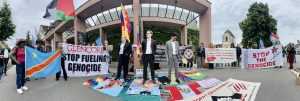
On 29 May, while the Annual General Meeting (AGM) of the multinational mining company Glencore was being held in Zug, Switzerland, a global day of action against Glencore also took place. There were protests in other cities, including Bogotá (Colombia), Frankfurt (Germany), Andalgalá (Argentina), Johannesburg (South Africa), London (UK), and the Netherlands. This year, solidarity with the Palestinian people and opposition to genocide was also highlighted, given the Swiss company’s involvement in supplying coal for electricity generating in Israel.
#ToxicGlencore was one of the messages displayed during the protest outside the casino in Zug. The protest was organised by the Swiss Coalition against Glencore, London Mining Network, and Resistencia Activa Ya. It was also one of the main issues raised by civil society representatives at the meeting. Leaders of trade unions from Colombia and South Africa, along with representatives of environmental and human rights organisations, expressed concerns about pollution, corruption, lack of transparency, and human rights violations by one of the world’s largest mining companies.
The Peru Support Group, as it did last year, asked questions about cases of toxic metal contamination in Espinar (Cusco) and Ancash, where the company operates, through its Coordinator, Sayuri Andrade. When asked about Glencore’s position on the causal report from OEFA, which confirms that the source of contamination is its mining operation at Antapaccay, the company’s CEO, Kalidas Madhavpeddi, once again denied the report’s conclusions. He stated that the company had conducted its own studies, which have never been made public, unlike other cases such as those in Quebec.
Regarding the findings of high levels of arsenic in the blood of children in Huarmey (Ancash), a city where Antamina has operations (of which Glencore owns a third), Madhavpeddi claimed to be unaware of the issue but offered to follow up with their Antamina partner on the matter. Finally, when asked about the implications of the Coroccohauyco expansion project in Espinar, the CEO did not provide a response.
On the same day in Peru, the National Platform of Communities Affected by Toxic Metals held a press conference. It expressed its disappointment with the company’s statements. “At the same time, in places like La Oroya, Pasco and Espinar, people are dying without anyone noticing”, said their president, Anthony Oscátegui, in a strongly worded statement.
Despite the company’s claims, Glencore in Peru fails to meet international standards when it comes to the environment and the rights of indigenous peoples. NGOs, media, and government bodies have all documented extensively the impacts in Espinar province. Yet, the company still only does the minimum required by law, and its conduct appears to have deteriorated over the past year. The company has sold most of its shares in Minera Volcan, but it is still selling the minerals from Volcan’s mines. These include those in Cerro de Pasco, where a 12-year-old girl died recently due to prolonged poisoning from heavy metals.

Recent Comments