
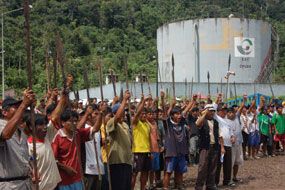
According to some press reports, peace in the Peruvian Amazon is tentative and there are fears that protests may erupt again as dialogue seems to have produced few results. Furthermore, a judge in Lima has requested that Interpol issue international arrest warrants against exiled AIDESEP (Inter-ethnic Association of Development of the Peruvian Jungle) leader Alberto Pizango and four other indigenous leaders.
A cross-party congressional commission has been formed to investigate the events that occurred in Bagua (Amazonas) in June. The aim of the Commission, which is made up of seven members of Congress is to investigate the causes and those responsible for the violence. It has 120 days to submit a report with its recommendations and conclusions.
The much called for ‘independent commission’ has been formed via a ministerial resolution. However, some Peruvian human rights organisations point out that because of the way in which the ‘Special Commission to Investigate and Analyse the Bagua Events’ was created, it will submit its report at ministerial level, in this case to the Ministry of Agriculture which holds the presidency of the National Coordination Group for the Development of Amazonian Peoples which was created in the aftermath of the violence. Its remit is to investigate the causes which gave rise to the events, not the actual events of 5th June. Also, human rights organisations say it has no mandate or capacity to investigate situations which fall within the responsibilities of other ministries, such as the Ministry of Justice or the Interior Ministry.
Indigenous Leaders Charged
While 17 police have been charged with homicide, more than 100 indigenous people have been charged with murder and rebellion. Three indigenous leaders have sought asylum in Nicaragua, including Alberto Pizango, President of AIDESEP.
These charges have recently intensified, as on 27th August Judge Carmen Arauco requested international arrest warrants from Interpol, the International Police Service, to extradite them to Peru.
The root of the conflict stems from rights to land and oil. In Peru, the government owns the rights to all subsoil resources, including oil, and consequently some 75% of the Peruvian Amazon is divided into oil concessions that overlap indigenous peoples’ ancestral lands.
Photographs © Thomas Quirynen

Recent Comments